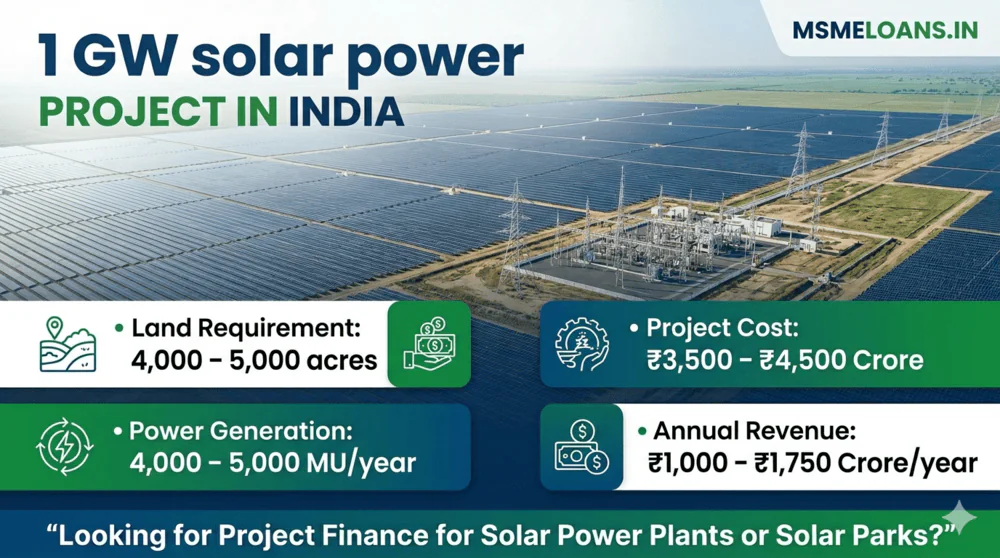
A 1 GW solar project typically requires ₹3,500+ Crore investment and can generate ₹1,000+ Crore annual revenue, making it one of the most scalable infrastructure opportunities in India.
A 1 Gigawatt solar power plant is one of the largest forms of infrastructure investment in the renewable energy sector. With India aggressively expanding its solar capacity, utility-scale solar projects offer long-term revenue visibility, stable cash flows, and strong investor interest. However, developing a 1 GW solar project requires careful planning, large-scale land aggregation, and structured project finance..
This guide explains the cost, land requirement, financing structure, revenue potential, and overall feasibility of a 1 GW solar power project in India.
What is a 1 Gigawatt Solar Power Project?
A 1 GW (Gigawatt) solar project represents 1000 MW of installed solar capacity. These projects are typically developed as large solar parks or utility-scale installations supplying electricity to DISCOMs, government agencies, or private buyers through long-term Power Purchase Agreements (PPAs). Such projects are usually executed in phases (100 MW–250 MW blocks) and require strong financial backing through project finance solutions.
How Much Land is Required for a 1 Gigawatt Solar Project?
Land is one of the most critical components of solar project development. Proper land planning is essential not only for approvals but also for securing project funding.
- Land per MW: 4–5 acres
- Total Land Required: 4,000 – 5,000 acres
The land should be flat, non-agricultural or convertible, and free from legal disputes. Proximity to substations or transmission lines is essential to reduce evacuation costs and ensure project feasibility.
What is the Cost of a 1 Gigawatt Solar Project in India?
The cost of a solar project depends on module prices, land development, EPC costs, and transmission infrastructure. To fund such large-scale investments, developers usually rely on solar project loans and structured financing models.
- Cost per MW: ₹3.5 Cr – ₹4.5 Cr
- Total Project Cost: ₹3,500 Cr – ₹4,500 Cr
Major cost components include solar panels, inverters, mounting structures, cabling, land preparation, grid connectivity, and engineering services.
How is Project Finance Structured for a 1 GW Solar Project?
Project finance is the backbone of any large-scale solar project. A 1 GW solar project is typically funded through a mix of debt and equity, structured to ensure long-term sustainability and predictable returns.
- Debt Financing: 70% – 75% of project cost
- Equity Contribution: 25% – 30%
- Loan Tenure: 10 – 18 years
- Interest Rate: 8% – 11%
For example, in a ₹4,000 Crore project, debt funding can go up to ₹3,000 Crore, while promoter equity would be around ₹1,000 Crore.
Loans are typically structured based on cash flow projections from the PPA, ensuring that debt servicing is aligned with project revenue. Lenders include public sector banks, NBFCs, infrastructure funds, and international financial institutions.
Key financing elements include:
- Power Purchase Agreement (PPA) with guaranteed tariff
- Special Purpose Vehicle (SPV) structure
- Debt Service Coverage Ratio (DSCR) compliance
- Escrow account for revenue management
This structured financing ensures low risk for lenders and predictable returns for investors.
How Much Power Does a 1 GW Solar Project Generate?
Power generation depends on solar irradiation and plant efficiency. Higher efficiency projects also improve loan eligibility under solar financing programs.
- Annual Generation for 1GW solar park : 4,000 – 5,000 Million Units (MU)
States like Rajasthan, Gujarat, and Telangana offer higher generation potential due to better solar radiation levels.
What is the Revenue and Income from a 1 GW Solar Project?
Revenue is generated through electricity sales under long-term PPAs.
- Tariff Range: ₹2.5 – ₹3.5 per unit
Estimated Annual Revenue:
- ₹1,000 Crore – ₹1,750 Crore per year
Net Profit (After Expenses):
- ₹200 Crore – ₹500 Crore annually
Profitability depends on financing cost, plant efficiency, and operational expenses.
What Government Support and Incentives Are Available for Solar Projects?
The Government of India provides several policy benefits to encourage solar energy investments:
- Waiver of interstate transmission charges
- Must-run status for solar plants
- Accelerated depreciation benefits
- Viability gap funding in select cases
- Support for renewable purchase obligations (RPO)
These incentives improve project viability and investor confidence.
What Factors Affect the Success of a 1 GW Solar Project?
- Availability of contiguous land parcels
- Proximity to transmission infrastructure
- Strong and bankable PPA
- Efficient EPC execution
- Timely financial closure
Failure in planning, execution, or financing can impact project timelines and returns. Choosing the right project finance partner is critical for success.
Why is Land Aggregation Important for a 1 GW Solar Project?
Land aggregation is one of the biggest challenges in solar project development. For a 1 GW project, developers need thousands of acres of contiguous land, often spread across multiple villages.
Leasing land instead of purchasing reduces upfront capital requirements and improves project viability.
Typical Requirement: 4,000+ acres with clear titles and long-term lease agreements.
Is a 1 GW Solar Project a Profitable Investment?
A 1 GW solar project is a high-investment, high-return infrastructure asset with long-term income potential. With stable tariffs and low operating costs, solar projects generate predictable cash flows for 20–25 years.
Key advantages include:
- Stable and long-term revenue
- Low operational risk
- Growing demand for clean energy
- Strong investor interest
If structured correctly, a 1 GW solar project can become a highly profitable and scalable infrastructure business.
What Are the Recent 1 GW Solar Power Projects in India?
India has seen significant growth in large-scale solar power projects, with multiple developers successfully commissioning and planning 1 GW+ projects across the country. These projects highlight the strong demand, financial viability, and scalability of solar energy investments.
Utility-Scale Solar Projects (1 GW+)
- SJVN / Tata Power (Bikaner, Rajasthan): Tata Power commissioned a 1 GW solar project for SJVN in 2026, using advanced bifacial modules with a total investment of approximately ₹5,491 Crore.
- Adani Green Energy (Khavda, Gujarat): Adani operationalized 1 GW capacity as part of its massive 30 GW renewable energy park, one of the largest in the world.
- NLC India Limited: Operates a large solar portfolio exceeding 1 GW capacity across multiple locations.
- ArcelorMittal: Planning 1 GW hybrid renewable energy capacity to support industrial power needs.
—
Solar Manufacturing Projects (1 GW+ Capacity)
- Aroma Solar (Haryana): Commissioned a 1.2 GW TOPCon solar module plant in 2026.
- Fujiyama Power Systems (Uttar Pradesh): Established a 1 GW solar cell manufacturing facility.
- True Power Limited (Uttar Pradesh): Developing a 1 GW solar panel manufacturing plant.
—
What Are the Key Economics of 1 GW Solar Projects?
- Project Cost: $800 Million – $1.2 Billion (₹6,500 Cr – ₹10,000 Cr approx)
- Annual Generation: ~2,400 – 5,000 Million Units depending on location
- Technology Used: High-efficiency N-Type TOPCon, bifacial modules, and advanced tracking systems
These real-world projects demonstrate that 1 GW solar developments are not only technically feasible but also financially viable at a large scale.
Looking to Develop or Finance a 1 GW Solar Project?
We provide complete support for land aggregation, project finance structuring, and investor connections for large-scale solar projects across India.
From 1 MW to 1 GW – End-to-End Solar Project Support
Call Now: 7799612369