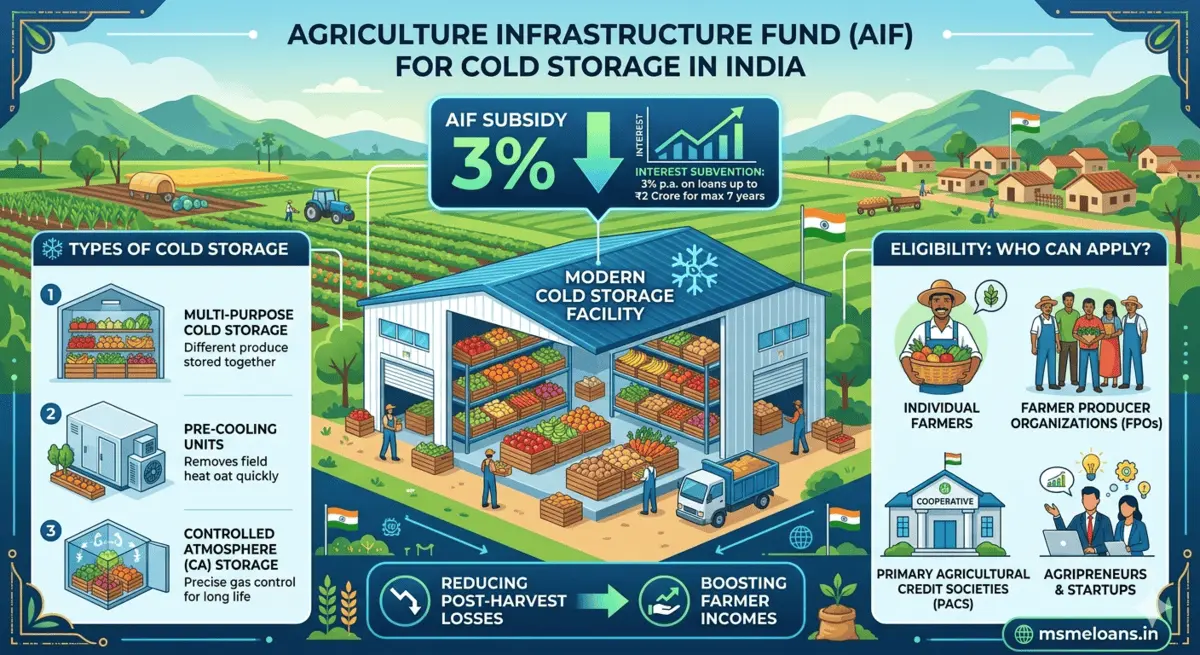
 What is Cold Storage in Agriculture?
Cold storage is a facility used to store perishable agricultural products under controlled temperature and humidity conditions. It helps maintain the freshness and quality of agricultural produce for longer durations.
Cold storage units are widely used for storing fruits, vegetables, dairy products, meat, and flowers. Without proper storage facilities, farmers often suffer losses because perishable goods spoil quickly. The Agriculture Infrastructure Fund for Cold Storage encourages the development of modern cold chain infrastructure to support farmers and agricultural businesses.
Types of Cold Storage in India
Cold storage facilities are designed based on the type of products stored. Choosing the right type of cold storage is important for maintaining quality, shelf life, and profitability.1. Fruit Cold Storage
Used for storing fruits like apples, oranges, bananas, and grapes under controlled temperature and humidity conditions. Advanced systems like controlled atmosphere (CA) storage help extend shelf life and maintain freshness.2. Vegetable Cold Storage
Designed cold storage for vegetables such as onion, potato, tomato, carrot, and leafy greens. Temperature and ventilation vary based on the product, making it one of the most widely used cold storage types in India. Highly suitable for onion and potato storage businesses.3. Multi-Commodity Cold Storage
This is the most profitable and flexible model, allowing storage of multiple products like onion, potato, garlic, fruits, and vegetables in a single facility. Best choice for traders, aggregators, and AIF-funded projects.4. Dairy Product Storage
Used for storing milk, butter, paneer, and other dairy products at low temperatures to prevent spoilage and maintain quality.5. Frozen Food Storage
Designed for deep freezing products like meat, seafood, and processed foods at sub-zero temperatures (typically -18°C or lower). Note: Among all types, multi-commodity cold storage (onion + potato + vegetables) is the most preferred option due to higher profitability and eligibility for AIF loans and government subsidy.Benefits of Agriculture Infrastructure Fund for Cold Storage Loan
The Agriculture Infrastructure Fund for Cold Storage offers multiple advantages to entrepreneurs and agricultural organizations.- Interest subsidy of up to 3% per year
- Loan support up to ₹2 crore
- Credit guarantee coverage through CGTMSE
- Reduced financial burden for infrastructure development
- Helps reduce post-harvest losses
- Improves farmers’ income
- Encourages rural entrepreneurship
- Supports development of modern cold chain infrastructure
Eligibility for Agriculture Infrastructure Fund Loan
To apply for an Agriculture Infrastructure Fund loan, applicants must meet certain eligibility criteria.- Individual farmers
- Farmer Producer Organizations (FPOs)
- Agricultural entrepreneurs
- Self Help Groups (SHGs)
- Cooperatives
- Agri startups
- Joint liability groups
- Agricultural logistics companies
Documents Required for AIF Loan
When applying for the AIF scheme, banks may require the following documents:- Aadhaar card
- PAN card
- Address proof
- Detailed project report
- Land ownership documents or lease agreement
- Bank statements (last 6–12 months)
- Business registration documents
- GST registration (if applicable)
- Financial statements
Estimated Project Cost for Cold Storage
The cost of setting up a cold storage facility varies depending on storage capacity, location, and technology used. Major cost components include:- Land acquisition or lease
- Construction of cold storage building
- Refrigeration equipment and compressors
- Insulated panels and storage racks
- Electrical installation and backup generators
- Temperature monitoring systems
- Material handling equipment
 Cold Storage Project Cost by Capacity in India
The cost of a cold storage project depends on capacity, technology, and level of automation. Below is a ranking of cold storage projects based on investment size and ideal use.
 Cold Storage Project Cost by Capacity in India
| Cold storage Sizes | Capacity | Project Cost | Ideal For | Subsidy Potential |
|---|---|---|---|---|
 Basic Cold Storage Basic Cold Storage |
100 MT | ₹15 – ₹20 Lakh | Small Business | Up to 35% |
 Medium cold storage Medium cold storage |
500 – 1000 MT | ₹1 – ₹11 Crore | Traders | 35% – 40% |
 Large Cold Storage Large Cold Storage |
2500 – 5000 MT | ₹2.5 – ₹10 Crore | FPOs / Wholesale | AIF + NHB Subsidy |
 Mega Cold Storage Mega Cold Storage |
10,000+ MT | ₹20 – ₹50+ Crore | Corporates | Multiple Schemes |
 Most investors prefer 2500–5000 MT cold storage projects as they offer better profitability and eligibility for AIF loans with subsidy benefits.
💰 Cold Storage Income, EMI & Profit Example (India)
The income from a cold storage business depends on capacity, storage charges, and occupancy rate. Below is a simple example to understand real earnings, including income, EMI, and profitability.
📊 Example: 3000 MT Cold Storage (Onion & Potato)
- Total Capacity: 3000 MT
- Average Storage Charges: ₹200 per MT per month
- Average Occupancy: 80%
💵 Monthly Income Calculation
3000 MT × 80% occupancy = 2400 MT utilized
2400 MT × ₹200 = ₹4,80,000 per month
📅 Annual Income
₹4,80,000 × 12 = ₹57,60,000 per year
💳 EMI & Loan Overview
- Estimated Project Cost: ₹4 – ₹5 Crore
- Loan Amount: ₹3 – ₹3.5 Crore
- Interest Rate (after AIF subsidy): ~7.5% – 8%
- Loan Tenure: 7 Years
👉 Estimated EMI: ₹5 – ₹5.5 lakh per month
⚖️ Income vs EMI (Reality Check)
👉 Monthly Rental Income: ₹4.8 lakh
👉 Monthly EMI: ₹5 – ₹5.5 lakh
❗ Observation: Rental income alone may not fully cover EMI in the initial years.
💡 How Cold Storage Becomes Profitable
Cold storage is not just a rental business. Most successful projects use a combination of:
- Storage rent (steady income)
- Seasonal trading (main profit)
- Additional services (extra income)
👉 Even using just 20–30% capacity for trading (onion/potato), owners can generate ₹30–80 lakh extra profit per year.
📈 Final Profit Potential
After combining rental income, trading profit, and additional services:
👉 Estimated Net Profit: ₹25 lakh – ₹60 lakh per year
👉 Note: Cold storage projects are most profitable when operated as a combination of storage + trading, not rental alone.
👉 Planning a cold storage project? Get funding up to ₹2–10 crore with AIF subsidy and build a profitable business.
How to Apply for Agriculture Infrastructure Fund Loan
The process for applying for an Agriculture Infrastructure Fund loan involves the following steps:- Prepare a detailed project report for the cold storage facility.
- Check agriculture infrastructure fund eligibility requirements.
- Approach a bank or financial institution participating in the AIF scheme.
- Submit the loan application along with required documents.
- The bank evaluates the project and financial feasibility.
- Loan approval and sanction are issued.
- Funds are released for project development.