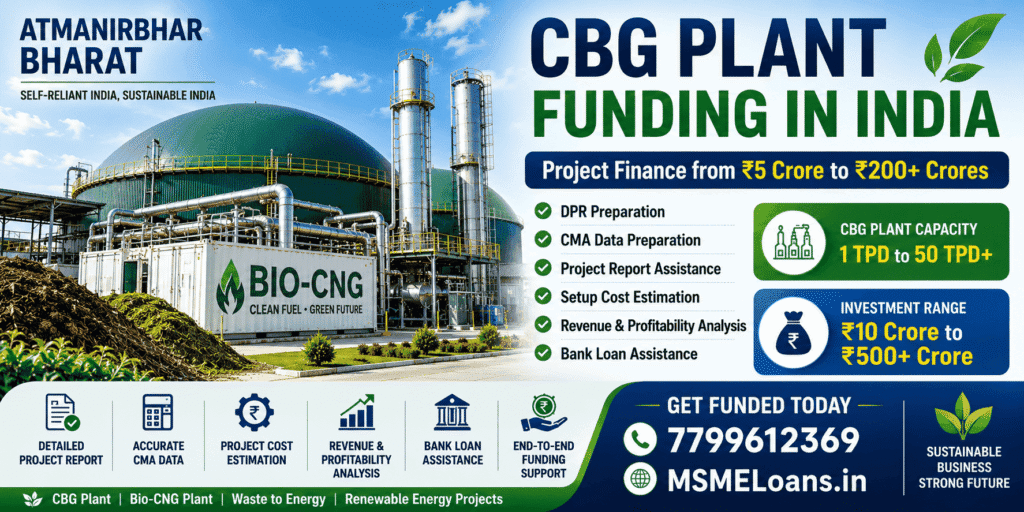
CBG Plant Funding, Setup Cost, Revenue & Profit Margin Guide
Table of Contents
ToggleIndia is rapidly emerging as a global leader in renewable energy and sustainable waste management. One of the fastest-growing sectors within this ecosystem is the Compressed Biogas (CBG) industry. Supported by government initiatives, rising demand for clean fuel, and growing environmental awareness, CBG plants offer a promising business opportunity for entrepreneurs, investors, farmers, sugar mills, distilleries, and waste management companies.
However, establishing a CBG plant requires substantial capital investment, detailed planning, and professional project execution. MSMELoans.in assists project promoters in securing funding from ₹5 Crore to ₹200+ Crores for Bio-CNG and Compressed Biogas projects across India.
What is a CBG Plant?
Compressed Biogas (CBG), also known as Bio-CNG, is a purified form of biogas produced through the anaerobic digestion of organic waste. Feedstock such as agricultural residue, cattle dung, press mud, municipal waste, food waste, and industrial organic waste is processed to generate biogas, which is then purified and compressed into CBG.
CBG has properties similar to conventional CNG and can be used for transportation, industrial fuel applications, power generation, and commercial energy requirements.
Why Invest in a CBG Plant in India?
- Growing demand for renewable energy
- Government support for Bio-CNG projects
- Long-term fuel offtake opportunities
- Multiple revenue streams
- Organic fertilizer sales
- Carbon credit opportunities
- Waste management income
- Strong environmental impact
With India’s focus on reducing fossil fuel imports and promoting sustainable energy, the CBG sector is expected to witness significant growth over the next decade.
Feedstock Used in CBG Plants
A CBG plant can operate using various types of organic waste.
- Cattle dung
- Poultry litter
- Agricultural residue
- Press mud from sugar factories
- Food processing waste
- Fruit and vegetable waste
- Municipal solid waste
- Distillery waste
- Industrial organic waste
How Does a CBG Plant Work?
1. Feedstock Collection
Organic waste is collected and transported to the plant.
2. Anaerobic Digestion
The feedstock is processed inside digesters where microorganisms break down organic matter in the absence of oxygen.
3. Biogas Generation
The digestion process generates raw biogas consisting mainly of methane and carbon dioxide.
4. Gas Purification
Impurities such as moisture, hydrogen sulfide, and carbon dioxide are removed.
5. Compression
The purified methane-rich gas is compressed to produce Bio-CNG or CBG.
6. Distribution
The gas is supplied to fuel stations, industries, transport operators, and commercial users.
CBG Plant Setup Cost in India
The project cost depends on capacity, technology provider, feedstock type, and location.
| CBG Output | Feedstock Input | Project Cost | Promoter Contribution | Bank Funding | Collateral Security | Annual Revenue | Operating Cost | Annual Net Profit | Payback Period |
|---|---|---|---|---|---|---|---|---|---|
| 1 TPD | 30 TPD | ₹10 Cr | ₹2.5 Cr | ₹7.5 Cr | ₹3.75 Cr | ₹4 Cr | ₹2.5 Cr | ₹1 Cr | 5-6 Years |
| 2 TPD | 75 TPD | ₹18 Cr | ₹4.5 Cr | ₹13.5 Cr | ₹6.75 Cr | ₹8 Cr | ₹5 Cr | ₹2 Cr | 5-6 Years |
| 5 TPD | 175 TPD | ₹40 Cr | ₹10 Cr | ₹30 Cr | ₹15 Cr | ₹20 Cr | ₹12 Cr | ₹5 Cr | 5-6 Years |
| 10 TPD | 350 TPD | ₹75 Cr | ₹18.75 Cr | ₹56.25 Cr | ₹28.13 Cr | ₹40 Cr | ₹24 Cr | ₹10 Cr | 5-6 Years |
| 20 TPD | 700 TPD | ₹150 Cr | ₹37.5 Cr | ₹112.5 Cr | ₹56.25 Cr | ₹80 Cr | ₹48 Cr | ₹20 Cr | 5-6 Years |
| 40-50 TPD | 1000 TPD | ₹500 Cr | ₹125 Cr | ₹375 Cr | ₹187.5 Cr | ₹200 Cr | ₹120 Cr | ₹50 Cr | 5-6 Years |
Note Actual project costs vary based on land availability, technology selection, storage facilities, and infrastructure requirements.
Revenue Potential of a CBG Plant
CBG plants can generate revenue from multiple sources, making them an attractive long-term investment opportunity.
1. Sale of Compressed Biogas (CBG)
The primary source of revenue is the sale of CBG to Oil Marketing Companies (OMCs), industrial consumers, transportation companies, CNG stations, and commercial users.
2. Organic Fertilizer Sales
The digestate generated during biogas production can be processed into organic manure and bio-fertilizers, creating an additional source of income.
3. Carbon Credits
CBG projects contribute to greenhouse gas emission reduction and may qualify for carbon credit benefits, depending on the project structure and applicable regulations.
4. Waste Processing Contracts
Municipal bodies, food processing companies, and industrial units often enter into long-term waste management agreements with CBG plant operators.
Expected Profit Margins in CBG Plants
Profitability depends on feedstock availability, transportation costs, plant efficiency, financing structure, and gas selling prices.
- Gross Profit Margin: 35% – 55%
- EBITDA Margin: 25% – 40%
- Project IRR: 15% – 25%
- Typical Payback Period: 5 – 6 Years
Projects with low-cost feedstock, efficient technology, and long-term offtake agreements generally achieve higher profitability and faster payback.
Does the Government Support CBG Plants in India?
Yes. The Government of India actively promotes Compressed Biogas (CBG) projects through various schemes and policy initiatives, making the sector attractive for investors and project developers.
- SATAT (Sustainable Alternative Towards Affordable Transportation) initiative to promote CBG production and consumption.
- Support from Oil Marketing Companies such as IOCL, BPCL, HPCL, GAIL, and IGL.
- Priority Sector Lending support for eligible projects.
- National Bioenergy Programme support for qualifying projects.
- Government focus on converting agricultural and organic waste into clean energy.
- Promotion of organic manure and waste-to-wealth initiatives.
- Support for rural employment generation and sustainable development.
The SATAT initiative aims to create a strong ecosystem for Bio-CNG and Compressed Biogas production by encouraging private investment and long-term market development.
CBG Plant Funding and Project Finance
Setting up a CBG plant requires substantial capital investment. MSMELoans.in assists project promoters in arranging project finance from ₹5 Crore to ₹200+ Crores for Bio-CNG, Renewable Energy, and Waste-to-Energy projects.
Funding solutions include:
- Project Finance
- Term Loans
- Construction Finance
- Working Capital Loans
- Machinery Finance
- Debt Syndication
- Renewable Energy Project Funding
- Infrastructure Finance
DPR, CMA and Project Report Assistance
Financial institutions typically require detailed project documentation before sanctioning loans. Our team assists with:
- Detailed Project Report (DPR)
- CMA Data Preparation
- Financial Projections
- DSCR Analysis
- Project Viability Assessment
- Bankable Business Plans
- Loan Proposal Preparation
Documents Required for CBG Plant Funding
- KYC Documents
- Company Registration Documents
- Promoter Profile
- Detailed Project Report (DPR)
- CMA Data
- Land Documents
- Feedstock Agreements
- Machinery Quotations
- Projected Financial Statements
- Bank Statements
- Net Worth Statements
Why Choose MSMELoans.in?
- Project Finance from ₹5 Crore to ₹200+ Crores
- Renewable Energy Project Funding Expertise
- DPR & CMA Preparation Assistance
- Project Finance Advisory
- Bank Loan Structuring Support
- End-to-End Funding Assistance
- Support for Greenfield and Expansion Projects
Contact Us for CBG Plant Funding
Planning to establish a CBG Plant, Bio-CNG Plant, Renewable Energy Project, or Waste-to-Energy Venture?
Get Project Finance from ₹5 Crore to ₹200+ Crores.
✓ DPR Preparation
✓ CMA Data Preparation
✓ Project Cost Estimation
✓ Revenue & Profitability Analysis
✓ Bank Loan Assistance
✓ Project Finance Advisory
Call / WhatsApp: 7799612369
Website: MSMELoans.in
Contact us today to discuss your CBG Plant Funding requirements and secure the right financing solution for your project.
Disclaimer
The information provided in this article is intended for general informational and educational purposes only. Project costs, funding eligibility, collateral requirements, revenue projections, operating expenses, profitability estimates, payback periods, and financial metrics mentioned herein are indicative in nature and may vary based on project location, feedstock availability, technology selection, plant capacity, market conditions, lender policies, regulatory approvals, and other project-specific factors.
Nothing contained in this article should be construed as financial, investment, legal, technical, or professional advice. Prospective investors and project promoters are advised to conduct their own due diligence and obtain professional guidance before making investment or financing decisions.
MSMELoans.in does not guarantee loan approval, funding sanction, project viability, profitability, subsidies, incentives, or financial returns. All funding proposals are subject to lender evaluation, credit assessment, documentation, collateral requirements, and applicable terms and conditions.
No related posts.