Preparing a proper business plan is one of the most important steps when applying for a bank loan to start a diagnostic center. Banks and NBFCs evaluate your business proposal to understand the investment required, expected income, and the financial viability of the project. A well-structured diagnostic center business plan helps lenders assess the potential of the business and your ability to repay the loan.
Diagnostic centers play an important role in modern healthcare because doctors rely on laboratory tests to diagnose diseases accurately. Due to the increasing demand for blood tests, imaging services, and preventive health checkups, diagnostic laboratories have become a profitable healthcare business opportunity in India. However, starting a diagnostic center requires significant investment in laboratory equipment, infrastructure, and working capital.
Many entrepreneurs apply for an MSME loan for diagnostic center to finance equipment purchase and clinic setup. In such cases, banks expect a detailed business plan explaining the services offered, equipment required, estimated revenue, and repayment capacity.
1. Business Overview
The first section of a diagnostic center business plan should provide an overview of the proposed business. This includes the name of the diagnostic center, location, services offered, and the target patient segment. Diagnostic centers typically provide pathology testing services such as blood tests, urine tests, thyroid tests, lipid profile tests, and preventive health checkup packages.
The business overview should also explain the reason for starting the diagnostic center and the demand for testing services in the selected location. If the center is located near hospitals, clinics, or residential areas, the chances of patient referrals and regular testing demand increase significantly.
2. Market Analysis
Market analysis helps banks understand the potential demand for diagnostic services in your area. In this section, you should explain the healthcare infrastructure near the proposed location, including hospitals, clinics, and existing diagnostic centers. Highlighting the increasing demand for medical testing due to lifestyle diseases and preventive health awareness strengthens your business proposal.
You should also mention your competitive advantage. For example, offering affordable testing packages, faster report delivery, or advanced diagnostic equipment can help attract more patients.
3. Equipment and Infrastructure Requirements
A diagnostic center requires specialized laboratory equipment and a well-organized clinical setup. The equipment required depends on the type of diagnostic services offered. Basic pathology laboratories typically require machines such as hematology analyzers, biochemistry analyzers, centrifuge machines, microscopes, and sample storage refrigerators.
In addition to equipment, the diagnostic center must have proper laboratory space, waiting area for patients, sample collection room, and administrative workspace. The business plan should clearly list all equipment and infrastructure requirements along with estimated costs.
4. Estimated Investment
The total investment required to start a diagnostic center depends on the scale of services and equipment installed. A small pathology laboratory may require an investment of ₹15 lakh to ₹25 lakh, while a full diagnostic center with imaging facilities may require higher investment.
| Expense Category | Estimated Cost |
|---|---|
| Laboratory Equipment | ₹10,00,000 – ₹15,00,000 |
| Clinic Setup and Interiors | ₹3,00,000 – ₹5,00,000 |
| Licenses and Registration | ₹50,000 – ₹1,00,000 |
| Working Capital | ₹3,00,000 – ₹5,00,000 |
This investment estimate helps lenders determine the required loan amount and evaluate the feasibility of the project.
5. Revenue Projection
A diagnostic center generates revenue through laboratory tests and health checkup packages. The business plan should include an estimate of daily patients, average test value, and expected monthly revenue.
| Parameter | Estimated Value |
|---|---|
| Average Patients per Day | 20 – 30 |
| Average Test Value | ₹500 |
| Daily Revenue | ₹10,000 – ₹15,000 |
| Monthly Revenue | ₹3,00,000 – ₹4,50,000 |
These projections help banks understand the expected cash flow and the ability of the business to repay the loan.
6. Loan Requirement
The business plan should clearly explain how much loan is required and how the funds will be used. Entrepreneurs usually apply for business loans to purchase laboratory equipment, set up the clinic, and manage working capital during the initial months.
Banks and NBFCs provide healthcare business loans, medical equipment loans, and MSME loans for diagnostic centers. These loans help entrepreneurs start or expand diagnostic laboratories without requiring large upfront capital.
7. Detailed Project Report (DPR) for Diagnostic Center
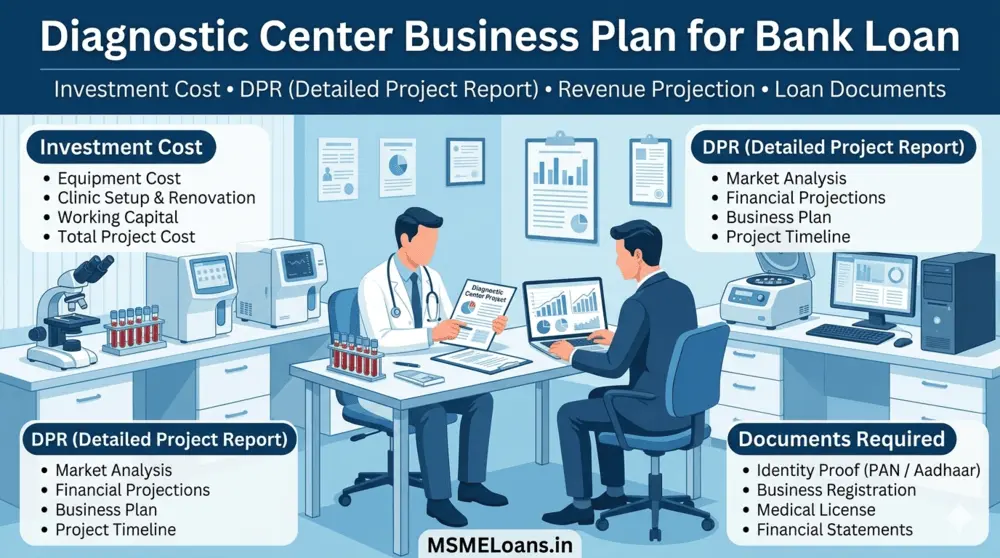
When applying for a bank loan to start a diagnostic center, lenders often require a Detailed Project Report (DPR). A DPR provides complete information about the proposed business, including investment requirements, operational plan, and financial projections. This document helps banks evaluate the feasibility and profitability of the diagnostic center.
A typical DPR for a diagnostic center should include the following details:
- Business profile of the promoter
- Location and infrastructure details of the diagnostic center
- List of laboratory equipment and machines
- Total project cost and investment structure
- Projected revenue and profit estimates
- Loan amount required and repayment plan
- Promotor Contribution
A well-prepared DPR increases the chances of getting approval for an
MSME loan for diagnostic center because it clearly explains the financial viability of the project.
8. Documents Required for Diagnostic Center Bank Loan
Banks and NBFCs require several documents when evaluating a loan application for starting a diagnostic center. These documents help lenders verify the identity of the applicant, business details, and financial stability.
Common documents required for a diagnostic center loan include:
- KYC documents (Aadhaar card, PAN card, address proof)
- Business registration documents
- Detailed Project Report (DPR)
- Diagnostic center business plan
- Medical qualification certificates of the pathologist
- Property documents or rental agreement for the clinic
- Bank statements of the applicant
- Quotation for laboratory equipment
Submitting these documents along with a clear business plan improves the chances of getting approval for a diagnostic center loan from banks or NBFCs.
Women Entrepreneur Benefits for Diagnostic Center Business
Loan for Women entrepreneurs who plan to start a diagnostic center may receive additional benefits from banks and government schemes. Many financial institutions encourage women-led businesses by offering slightly lower interest rates, reduced processing fees, or special loan programs.
To qualify as a women-owned business, the diagnostic center must usually have at least 51% ownership held by a woman entrepreneur. When the business meets this requirement, banks may classify it under women entrepreneur schemes and provide favorable loan terms.
Several government initiatives also support women entrepreneurs starting healthcare businesses such as diagnostic laboratories. Programs like the Stand-Up India Scheme and Mudra loans help women access funding to purchase medical equipment, set up laboratories, and manage working capital.
Women entrepreneurs planning to start a lab can also explore funding options such as an MSME loan for diagnostic center, which can help finance diagnostic equipment, clinic setup, and operational expenses.
Conclusion
A well-prepared diagnostic center business plan increases the chances of getting approval for a bank loan. By clearly presenting the investment required, equipment list, market demand, and revenue projections, entrepreneurs can demonstrate the financial viability of the project. Proper planning and funding support make it easier to establish a successful diagnostic center and serve the growing healthcare needs of patients.