Preparing a bankable Detailed Project Report (DPR) is the most critical step in securing a Greenfield Project Loan. Whether you are setting up a new manufacturing unit, warehouse, hotel, hospital, or food processing plant, banks evaluate your DPR before sanctioning project finance.
A professionally structured DPR improves loan approval chances, strengthens banker confidence, and ensures faster sanction.
What is a DPR in Greenfield Project Finance?
A Detailed Project Report (DPR) is a comprehensive document submitted to banks explaining:
- Project feasibility
- Technical viability
- Market demand
- Financial sustainability
- Repayment capacity
Banks use the DPR to evaluate the long-term viability and risk of funding the project.
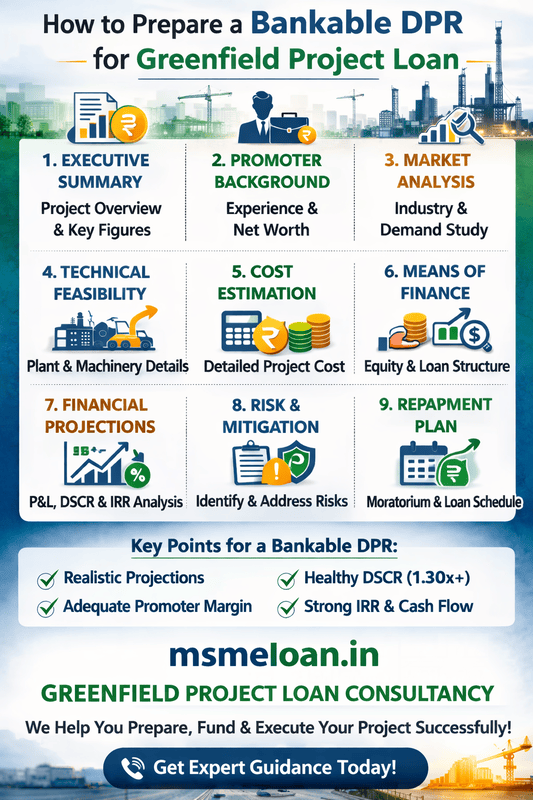
Structure of a Bankable DPR for Greenfield Project
1. Executive Summary
This is the first section bankers read. It should include:
- Project name and location
- Industry sector
- Total project cost
- Promoter contribution
- Term loan requirement
- Debt–Equity ratio
- Project IRR
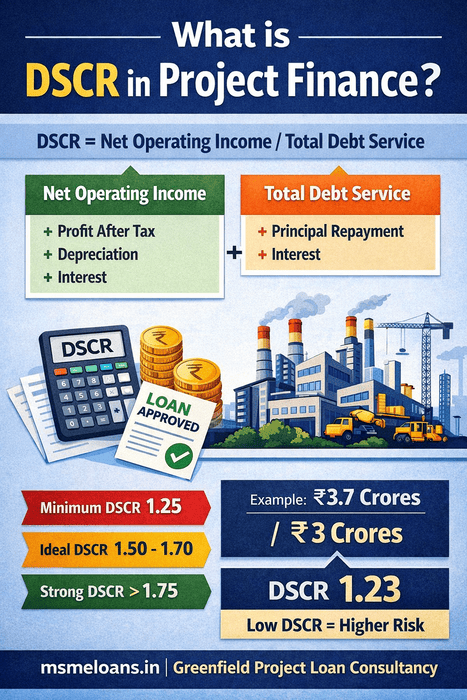
- Average DSCR
- Break-even year
Keep this section clear, professional, and data-driven.
2. Promoter Profile & Background
Banks finance promoters, not just projects. Include:
- Educational background
- Industry experience
- Existing business performance
- Net worth statement
- Income Tax Returns (last 3 years)
- CIBIL score
If the promoter lacks experience, justify the project with technical team support.
3. Industry & Market Analysis
This section must demonstrate demand viability. Include:
- Industry overview
- Market size and growth rate
- Demand–supply gap
- Target customer segment
- Competitor analysis
- Pricing strategy
Avoid unrealistic revenue assumptions.
4. Technical Feasibility
Banks verify whether the project can be practically executed. Include:
- Location advantages
- Land ownership or lease details
- Building plan and layout
- Machinery details with quotations
- Installed production capacity
- Manufacturing process flow
- Raw material availability
- Power and water requirements
Attach machinery quotations wherever possible.
5. Project Cost Estimation
Clearly break down total project cost into:
- Land cost
- Building & civil construction
- Plant & machinery
- Electrical installation
- Preliminary & pre-operative expenses
- Contingency provision
- Margin for working capital
- Interest During Construction (IDC)
Total Project Cost = Fixed Capital + Working Capital Margin
6. Means of Finance
Explain funding structure clearly:
- Promoter contribution (normally 25%–35%)
- Term loan
- Subsidy (if applicable)
- Unsecured loans (if any)
Maintain a realistic Debt–Equity Ratio (generally 2:1).
7. Financial Projections (Most Critical Section)
This section determines loan approval. Prepare:
- Projected Profit & Loss (7–10 years)
- Projected Balance Sheet
- Cash Flow Statement
- DSCR calculation
- Break-even analysis
- IRR calculation
- Sensitivity analysis
Minimum Banking Standards:
- Average DSCR: 1.30x – 1.50x
- Project IRR greater than loan interest rate
- Positive operational cash flow
Avoid overestimating sales projections.
8. Moratorium & Repayment Structure
- Construction period timeline
- Moratorium period (usually 12–24 months)
- Loan tenure (7–10 years normally)
- Structured repayment aligned with cash flow
Repayment schedule must match realistic project performance.
9. Risk Analysis & Mitigation
Include a clear risk assessment section:
- Market risk
- Raw material price risk
- Operational risk
- Competition risk
- Regulatory risk
Mention mitigation strategies for each identified risk.
Common Mistakes in DPR Preparation
- Inflated revenue projections
- Ignoring working capital requirements
- Incorrect DSCR calculations
- No contingency provision
- Weak promoter justification
- Absence of sensitivity analysis
These errors often result in loan rejection.
Documents Required Along with DPR
- Land documents
- Building approvals
- Machinery quotations
- Net worth certificate
- Income Tax Returns
- Bank statements
- Pollution clearance (if required)
- Projected CMA data
What Makes a DPR Truly Bankable?
- Realistic financial projections
- Healthy and consistent DSCR
- Adequate promoter margin
- Strong project IRR
- Justified market demand
- Clear risk mitigation strategy
Conclusion
A Greenfield Project Loan requires structured planning, accurate financial modelling, and professional documentation. A properly prepared DPR significantly improves loan approval chances and enhances banker confidence.
If you are planning a new industrial or infrastructure project, ensure your DPR meets banking standards before submission.