 The Compressed Biogas (CBG) sector is emerging as one of India’s fastest-growing renewable energy industries. Supported by the Government of India’s SATAT initiative and increasing demand for sustainable fuels, CBG plants offer attractive opportunities for investors, entrepreneurs, sugar mills, distilleries, and waste management companies.
However, establishing a CBG plant involves obtaining various approvals, licenses, and certifications from regulatory authorities. Understanding these requirements is crucial for smooth project execution, regulatory compliance, and successful project financing.
The Compressed Biogas (CBG) sector is emerging as one of India’s fastest-growing renewable energy industries. Supported by the Government of India’s SATAT initiative and increasing demand for sustainable fuels, CBG plants offer attractive opportunities for investors, entrepreneurs, sugar mills, distilleries, and waste management companies.
However, establishing a CBG plant involves obtaining various approvals, licenses, and certifications from regulatory authorities. Understanding these requirements is crucial for smooth project execution, regulatory compliance, and successful project financing.
Planning to set up a CBG plant? Before understanding the certifications and approvals required, it is important to evaluate the project cost, funding requirements, revenue potential, profitability, and bank loan eligibility. Read our detailed guide on CBG Plant Funding in India to learn about project finance, setup costs, DPR preparation, CMA data, and funding options from ₹5 Crore to ₹200+ Crores.
Why Are Certifications Important for CBG Plants?
CBG plants handle organic waste, produce compressed gas, and operate industrial machinery. Regulatory approvals ensure environmental compliance, operational safety, gas quality standards, and public safety. Most banks and financial institutions also require key approvals before sanctioning project finance for Bio-CNG and Compressed Biogas projects.Key Certifications and Approvals Required for a CBG Plant
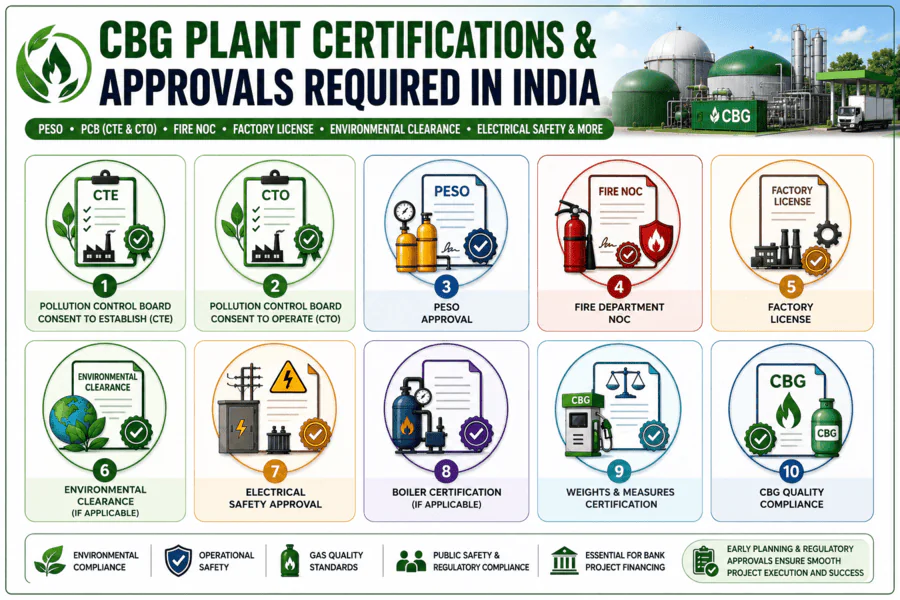
1. Pollution Control Board Consent to Establish (CTE)
Before starting construction, project developers must obtain Consent to Establish (CTE) from the State Pollution Control Board. This approval confirms that the proposed project complies with environmental regulations.2. Pollution Control Board Consent to Operate (CTO)
Once construction is completed and the plant is ready for operations, Consent to Operate (CTO) must be obtained from the State Pollution Control Board.3. PESO Approval
PESO (Petroleum and Explosives Safety Organisation) approval is one of the most important approvals for CBG plants. Since compressed gas is stored and handled under pressure, PESO approval is generally required for gas storage systems, cascades, and compression facilities.4. Fire Department NOC
A Fire No Objection Certificate (NOC) is generally required to ensure compliance with fire safety regulations and emergency response requirements.5. Factory License
CBG plants operating as industrial facilities may require a Factory License under applicable state regulations.6. Environmental Clearance (If Applicable)
Depending on project size, location, and feedstock type, Environmental Clearance may be required from the relevant authorities.7. Electrical Safety Approval
Electrical installations, transformers, generators, and industrial electrical systems must comply with safety standards and local regulations.8. Boiler Certification (If Applicable)
If the project includes boilers or steam-generating equipment, the necessary boiler approvals and inspections may be required.9. Weights & Measures Certification
Projects supplying CBG through dispensing stations may require certification under applicable Legal Metrology and Weights & Measures regulations.10. CBG Quality Compliance
CBG supplied to industrial consumers or Oil Marketing Companies must meet applicable quality specifications regarding methane content, moisture, sulfur content, and other parameters.SATAT Scheme and CBG Plant Approvals
The Government of India’s SATAT (Sustainable Alternative Towards Affordable Transportation) initiative encourages private investment in Compressed Biogas projects. Developers planning to supply gas under the SATAT ecosystem may also need to comply with additional technical and commercial requirements specified by Oil Marketing Companies.Approvals Commonly Reviewed by Banks
When evaluating project finance proposals, lenders generally pay close attention to the following approvals:- Pollution Control Board Approvals (CTE & CTO)
- PESO Approval Status
- Fire NOC
- Factory License
- Environmental Compliance
- Land Approvals
- Feedstock Availability
- Technical Feasibility