A Complete Guide to Financing Your Compressed Biogas Plant (2026)
Under the SATAT Scheme | Government-Backed | Bank Lending
India is racing toward a clean energy future, and Compressed Biogas (CBG) is at the heart of it. Launched under the SATAT (Sustainable Alternative Towards Affordable Transportation) scheme in October 2018, CBG is produced from organic waste — including agricultural residue, cattle dung, sugarcane press mud, and municipal solid waste — through anaerobic decomposition. With calorific value similar to Compressed Natural Gas (CNG), CBG can directly replace CNG in automotive, industrial, and commercial applications.
The Government of India plans to roll out 5,000 CBG plants across the country, targeting 15 million tonnes of CBG per annum — roughly 40% of India’s current CNG consumption. With a CBG blending mandate rolling out from FY 2025–26, there has never been a better time to invest in a CBG plant.
One of the biggest questions for entrepreneurs: Which banks give loans for CBG plants? The good news is that the RBI has classified CBG plant loans (up to ₹50 crore for startups) under Priority Sector Lending, and more than 10 major banks have developed exclusive loan schemes for CBG projects.
Why CBG Plant Financing Is More Accessible Than You Think
Unlike many businesses that struggle to secure loans, CBG plant developers enjoy several government-backed advantages:
- RBI Priority Sector Classification: Loans up to ₹50 crore for CBG startups qualify as priority sector lending, making banks more willing to lend.
- 100% Offtake Guarantee: Oil Marketing Companies (OMCs) like IOCL, BPCL, and HPCL provide Letters of Intent (LOI) guaranteeing CBG purchase — drastically reducing lender risk.
- Capital Subsidy (CFA): Ministry of New and Renewable Energy (MNRE) offers up to ₹10 crore per project as Central Financial Assistance.
- Agriculture-Allied Activity Status: CBG plants are classified as agri-allied activity, making them eligible for concessional term loan rates.
- Debt-Equity Ratio: Projects can be funded at a 70:30 debt-to-equity ratio, reducing entrepreneur capital requirements.
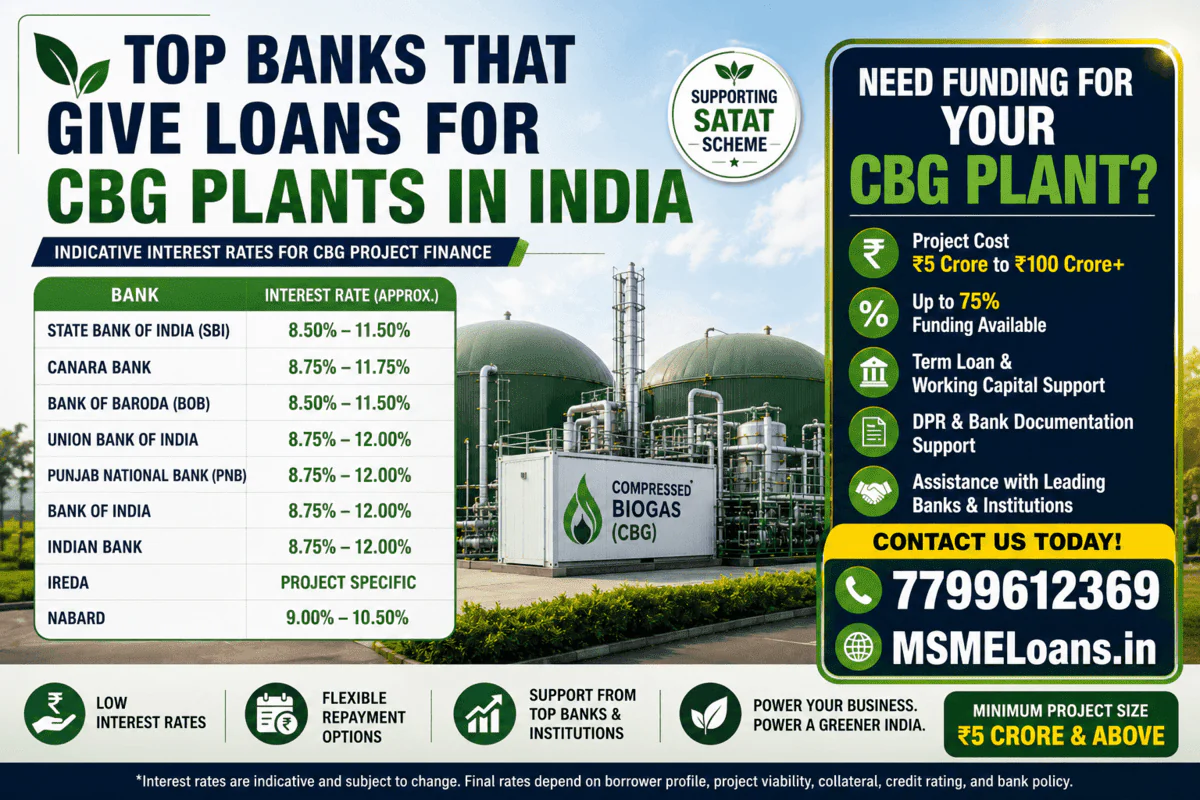
List of Banks that Give Loans for CBG Plants 2026
1. State Bank of India (SBI)
Best for: Large-scale CBG projects seeking the trust of India’s largest public sector bank
SBI has developed an exclusive loan product for CBG plant financing under the SATAT scheme. As India’s largest bank, SBI classifies CBG loans under Priority Sector – Agriculture – Ancillary Activities, making entrepreneurs eligible for competitive interest rates. SBI’s scheme covers term loans, working capital, and bank guarantees.
- Max loan limit: Up to ₹100 crore per borrower from the banking system
- Loan-to-project cost: Up to 75% of estimated/actual project cost
- Minimum plant capacity: 2 Tons Per Day (TPD) of CBG
- Eligibility: Entities holding a valid Letter of Intent (LOI) from an Oil Marketing Company
2. Canara Bank
Best for: Entrepreneurs looking for a dedicated CBG loan scheme from a major nationalised bank
Canara Bank has created a specific loan initiative for compressed biogas plants under the SATAT scheme. The bank supports the Indian government’s clean energy goals and has positioned CBG lending as a core part of its sustainable financing portfolio. Canara Bank offers term loans for setting up CBG plants, with facilities for working capital as well.
- Loan types: Term loan, working capital facilities
- Priority sector classification: Agriculture ancillary activities
- Supports: Setting up new CBG plants under SATAT
3. Bank of Baroda
Best for: Entrepreneurs seeking competitive interest rates with a clear, structured application process
Bank of Baroda offers one of the most clearly documented CBG loan schemes in India. Their product covers working capital, term loans, bank guarantees, and Letters of Credit for CBG plant projects. Their eligibility criteria are well defined, making it a go-to option for first-time CBG entrepreneurs.
- Facility types: Working Capital, Term Loan, Bank Guarantee / LC
- Eligible projects: CBG plants with minimum capacity of 2 TPD
- Eligible beneficiaries: Sole proprietors, partnerships, LLPs, companies, and cooperatives with LOI from OMCs
- Required documents: Business plan, ID proof (Aadhaar, passport), land records, project feasibility report
4. Union Bank of India (Union CBG Scheme)
Best for: Businesses wanting transparent loan terms and subsidy integration
Union Bank of India has a dedicated product called the Union CBG Scheme, which is one of the most transparent CBG financing products available. They clearly define loan quantum, margin requirements, subsidy treatment, and eligibility — making the application process straightforward. MNRE’s Capital Financial Assistance (CFA) is released directly into the borrower’s loan account after the plant achieves Commercial Operations Date (COD).
- Loan quantum: Up to 75% of estimated project cost
- Working capital margin: Minimum 25%
- CFA treatment: Subsidy credited to loan account post-COD to offset principal
- Agriculture Infrastructure Fund: CBG plants can also be financed under AIF for eligible cooperatives, FPOs, and agri-entrepreneurs
5. Punjab National Bank (PNB)
Best for: North India-based CBG entrepreneurs with agri-sector backgrounds
PNB is among the leading public sector banks that have developed an exclusive loan scheme for CBG projects under the SATAT initiative. With a strong presence in agricultural states like Punjab, Haryana, and Uttar Pradesh — which have high feedstock availability for CBG — PNB is well-positioned to serve CBG plant entrepreneurs in these regions.
- Loan types: Term loan, working capital
- Priority sector: Yes, under agriculture ancillary activities
- Especially useful for: Agri-waste-based CBG projects in North India
6. IREDA (Indian Renewable Energy Development Agency)
Best for: Renewable energy-focused CBG developers seeking specialised green financing
IREDA is India’s premier financing institution for renewable energy projects and has a dedicated CBG loan scheme under SATAT. IREDA loans cover up to 70% of project costs, making them one of the most substantial financing sources available. As CBG aligns directly with IREDA’s mandate of promoting clean energy, it gives favourable terms to CBG developers.
- Loan coverage: Up to 70% of total project cost
- Eligible projects: CBG plants under SATAT with OMC offtake agreements
- Subsidy handling: CFA and state subsidies adjusted against IREDA loan outstanding
- DSCR requirement: Minimum annual DSCR of 1.0 and average DSCR of 1.10
- Revenue from byproducts like bio-manure can be included in cash flow projections
7. NABARD (National Bank for Agriculture and Rural Development)
Best for: Rural and agriculture-based CBG plant entrepreneurs
NABARD provides project financing for CBG plants through its Rural Infrastructure Development Fund (RIDF) and direct lending mechanisms. NABARD also offers interest subvention that can effectively cut borrowing costs by 2–3%, and extends financing with priority sector benefits that make it an attractive option for agri-linked CBG projects.
- Interest rates: Competitive at 9–10% p.a.
- Repayment period: 12–15 years
- Interest subvention: 2–3% reduction in effective borrowing cost
- Best suited for: Rural CBG plants using agricultural residue and cattle dung as feedstock
8. Bank of India
Best for: Entrepreneurs in eastern and central India seeking a public sector banking partner
Bank of India is one of the ten major banks that have developed exclusive loan products for CBG projects under the SATAT initiative. With a wide branch network across rural and semi-urban India, Bank of India is accessible to CBG entrepreneurs in regions with high organic waste availability.
- Loan types: Term loan, working capital
- Priority sector: Yes, under agriculture ancillary activities
- Network: Wide rural and semi-urban branch presence across eastern and central India
9. Bank of Maharashtra
Best for: CBG entrepreneurs in Maharashtra and western India
Bank of Maharashtra has signed up to the SATAT banking initiative and offers dedicated CBG plant loans. Maharashtra, being one of the states with an active State Level Committee for SATAT implementation, makes Bank of Maharashtra a natural local financing partner for CBG projects in the state.
- Loan types: Term loan, working capital
- Priority sector: Yes, under agriculture ancillary activities
- Ideal for: Maharashtra-based CBG projects using sugarcane press mud and agri-waste
10. Indian Bank
Best for: South India-based CBG plant developers
Indian Bank is among the ten PSU banks with a dedicated CBG financing scheme. With strong roots in southern India — including Andhra Pradesh, Tamil Nadu, and Telangana — Indian Bank is a relevant choice for CBG entrepreneurs in these states where sugarcane press mud and municipal solid waste provide excellent feedstock.
- Loan types: Term loan, working capital
- Priority sector: Yes, under agriculture ancillary activities
- Ideal for: South India CBG projects with agri-waste and MSW feedstock
Quick Comparison of CBG Loan Providers
| Bank / Institution | Max Loan | Loan Coverage | Best For |
|---|---|---|---|
| State Bank of India | Up to ₹100 Cr | 75% of project cost | Large-scale projects |
| Canara Bank | ₹100 Cr (system) | Up to 75% | Nationalised bank trust |
| Bank of Baroda | ₹100 Cr (system) | Up to 75% | Structured process |
| Union Bank of India | Up to 75% cost | Up to 75% | Transparent scheme |
| Punjab National Bank | ₹100 Cr (system) | Up to 75% | North India agri-waste |
| IREDA | Per project | Up to 70% | Green energy focus |
| NABARD | Per project | RIDF norms | Rural CBG plants |
| Bank of India | ₹100 Cr (system) | Up to 75% | Central & East India |
| Bank of Maharashtra | ₹100 Cr (system) | Up to 75% | Maharashtra |
| Indian Bank | ₹100 Cr (system) | Up to 75% | South India |
Government Subsidies & Incentives to Stack With Your Loan
One major advantage of setting up a CBG plant in India is the ability to combine bank loans with government subsidies, significantly reducing your effective capital requirement:
- MNRE Capital Financial Assistance (CFA): Up to ₹10 crore per project (₹4 crore per 4,800 kg/day CBG capacity)
- GOBARdhan Scheme: Additional support for biogas projects linked to waste management
- Agriculture Infrastructure Fund (AIF): CBG plants qualify for AIF financing if set up by eligible entities like FPOs, cooperatives, and agri-startups
- State-level incentives: Gujarat offers 5% interest subsidy for 5 years; Punjab provides feedstock transport subsidies
- Carbon credits & excise duty exemptions: Additional financial benefits that improve project IRR
A typical model: For a 10 TPD plant costing ₹25 crore, you could receive ₹8 crore in subsidies, finance ₹12 crore through a bank loan, and contribute just ₹5 crore in equity — making the project highly capital-efficient.
How to Apply for a CBG Plant Loan
Step 1: Register on BioURJA Portal
The Ministry of Petroleum and Natural Gas manages the SATAT scheme through the BioURJA portal. Register your expression of interest here for an LOI from an Oil Marketing Company.
Step 2: Receive LOI from OMC
Once evaluated, an OMC (IOCL, BPCL, or HPCL) will issue you a Letter of Intent guaranteeing offtake of your CBG. This is your key document for bank financing.
Step 3: Prepare Your Project Report (DPR)
Prepare a Detailed Project Report covering plant capacity, feedstock source, technology provider, financial projections, and land details.
Step 4: Approach a Participating Bank
Submit your LOI, DPR, and supporting documents to any of the banks listed above. All ten PSU banks have dedicated CBG schemes under SATAT.
Step 5: Loan Sanction & Subsidy Application
After loan sanction, apply for MNRE’s CFA. The subsidy is released directly into your loan account after the plant achieves Commercial Operations Date (COD).
Final Thoughts
Compressed Biogas is one of India’s most exciting clean energy opportunities — and unlike many green businesses, CBG plant financing is well-supported by both the government and the banking sector. With top 10 major banks offering CBG plant loan schemes, IREDA and NABARD providing specialist green financing, and generous MNRE subsidies reducing capital burden, there has never been a more favourable time to set up a CBG plant in India.
The key to success is securing your LOI from an Oil Marketing Company first — once you have that, doors to financing open significantly. Choose a bank based on your location, project scale, and relationship, and don’t forget to stack government subsidies alongside your loan for the best financial outcome.
Disclaimer: This article is for informational purposes only. Loan terms, interest rates, and subsidy details are subject to change. Always verify current scheme guidelines with the respective bank or government authority before making any financial decisions.