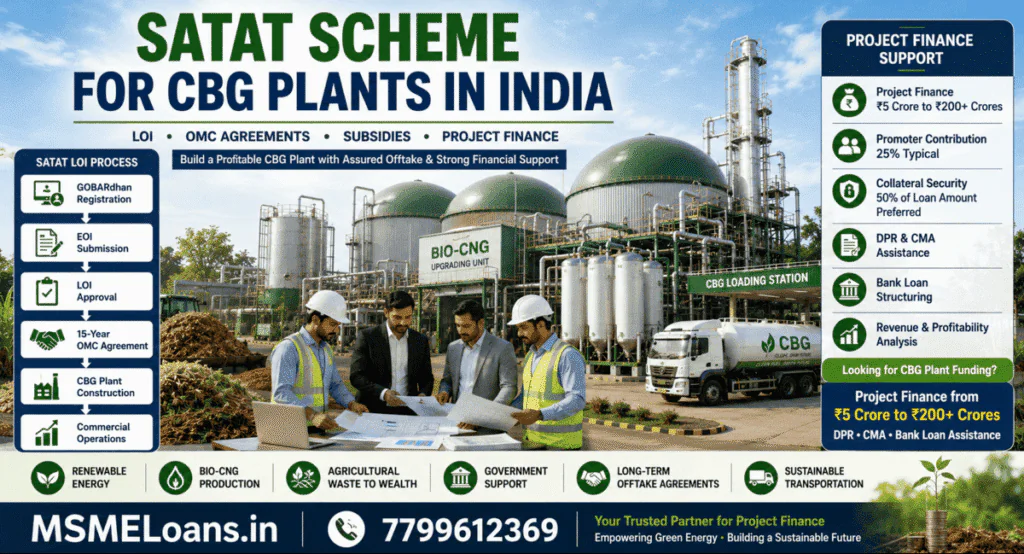
What is the SATAT Scheme? A Complete Guide for CBG Entrepreneurs
If you are planning to set up a Compressed Biogas (CBG) plant in India, the SATAT scheme is the single most important government programme you need to understand. It determines your offtake agreement, your procurement price, your bank loan eligibility, and your entire project viability.
This guide covers everything — what SATAT is, how to apply, how much OMCs pay, what the 2025–26 mandatory blending means for your earnings, and what subsidies you can stack on top.
What is the SATAT Scheme?
SATAT stands for Sustainable Alternative Towards Affordable Transportation. It was launched on 1st October 2018 by the Ministry of Petroleum and Natural Gas (MoP&NG) with a single clear goal — build a nationwide ecosystem for producing and distributing Compressed Biogas (CBG) as an alternative to fossil fuels.
Under SATAT, Oil Marketing Companies (OMCs) — primarily IOCL (Indian Oil), BPCL (Bharat Petroleum), and HPCL (Hindustan Petroleum) — invite entrepreneurs through Expression of Interest (EOI) to set up CBG plants. These OMCs then sign long-term offtake agreements to purchase all CBG produced at a fixed minimum price.
The SATAT scheme’s original targets:
- 250 CBG plants by 2020
- 1,000 CBG plants by 2022
- 5,000 CBG plants producing 15 million tonnes of CBG annually by 2025
The scheme positions CBG as a direct replacement for CNG in automotive and industrial use, and allows distribution through India’s existing CNG station network.
Who Can Apply for SATAT?
The SATAT scheme is open to a wide range of applicants:
- Individual entrepreneurs and private companies
- Farmers and farmer producer organisations (FPOs)
- Sugar mills and distilleries (with press mud / spent wash as feedstock)
- Municipal bodies and urban local bodies (with municipal solid waste)
- Waste management companies
- Agricultural cooperatives
- Existing biogas plant operators looking to upgrade to CBG
- SPVs (Special Purpose Vehicles) set up specifically for CBG projects
There is no minimum turnover requirement to apply for an LOI, making this accessible to first-time project developers as well.
SATAT Scheme — Key Benefits for Entrepreneurs
| Benefit | Detail |
|---|---|
| Assured Offtake | OMC purchases all CBG produced at guaranteed minimum price |
| Long-Term Agreement | 15-year commercial agreement with OMC, extendable on mutual consent |
| Priority Sector Lending | CBG projects included in PSL by RBI — easier bank loan access |
| Stable Revenue | Minimum procurement price guaranteed till 31st March 2029 |
| Multiple Revenue Streams | CBG sale + organic fertilizer + carbon credits + waste gate fees |
| No Take-or-Pay Risk | No penalty to plant owner if OMC fails to lift CBG |
| Transport Support | Additional ₹1.5–₹2.5/kg for plants delivering beyond 50 km |
CBG Procurement Price Under SATAT
The procurement price is the rate at which OMCs purchase CBG from your plant. This is the core revenue driver of your project.
Current pricing structure (effective June 2025 onwards):
The procurement price is now linked to 85% of the average CNG retail price across GAIL-associated City Gas Distribution (CGD) companies. This revision (from the earlier 80% formula) was notified in May 2025 and took effect from June 1, 2025.
As of 2026, the effective procurement price ranges from ₹62 to ₹72 per kg depending on location and calorific value of the CBG supplied.
Key conditions for price eligibility:
- CBG must be purified as per IS 16087:2016 standards
- Gas must be compressed to 250 bar pressure
- Delivered to OMC Retail Outlets in cascades within 25 km from the CBG plant
Transportation support (for plants beyond 25 km):
- ₹1.5/kg for delivery between 50–75 km
- ₹2.5/kg for delivery beyond 75 km
Important: The minimum procurement price will not fall below ₹46/kg for the period up to 31st March 2029, regardless of market fluctuations.
Step-by-Step: How to Get LOI Under SATAT
Getting a Letter of Intent (LOI) from an OMC is the first and most critical step. Here is the exact process:
Step 1 — Register on GOBARdhan Portal
Before submitting an EOI to any OMC, register your project on the GOBARdhan portal (gobardhan.gov.in) and obtain a registration number. This is mandatory.
Step 2 — Submit Expression of Interest (EOI)
Submit your EOI to one or more of the three OMCs — IOCL, BPCL, or HPCL. You can apply to multiple OMCs simultaneously. The EOI includes:
- Project details (location, feedstock, proposed CBG capacity)
- Promoter background and financials
- Land documents or land availability declaration
- Feedstock availability confirmation
Step 3 — OMC Evaluation
The concerned OMC evaluates your EOI based on feedstock availability, location viability, promoter capacity, and proposed plant size. This process can take 1–3 months.
Step 4 — LOI Issuance
If your EOI qualifies, the OMC issues a Letter of Intent (LOI) to you. The LOI is not the final agreement — it is a commitment to negotiate and finalise the commercial arrangement.
Step 5 — Submit Bank Guarantee
After accepting the LOI, you must submit a bank guarantee to the OMC:
- New plant (greenfield): ₹5 lakh per CBG plant
- Existing plant (upgrading from biogas to CBG): ₹1 lakh per CBG plant
Step 6 — Finalise Retail Outlets (ROs)
In consultation with you, the OMC allocates Retail Outlets (fuel stations) where you will deliver your CBG. The number of ROs depends on your proposed production capacity. Feedback from the LOI holder is taken before RO finalisation.
Step 7 — Execute Commercial Agreement
Once ROs are confirmed, a 15-year Commercial Agreement is signed between you and the OMC. This agreement covers:
- Plant location and production capacity
- RO allocation details
- Pricing model applicable
- Delivery terms and cascade specifications
Step 8 — Plant Construction and Commissioning
Proceed with plant construction. SATAT guidelines allow reasonable time extensions for construction — extension requests are routinely granted if genuine. Once commissioned, commercial CBG supply begins under the agreement.
Documents Required for SATAT LOI Application
- GOBARdhan registration number
- KYC documents (Aadhaar, PAN, company registration)
- Promoter profile and net worth statement
- Proposed plant location details and land documents
- Feedstock availability assessment
- Proposed CBG production capacity (TPD)
- Basic project concept note or DPR
- Bank statements (last 12 months)
- IT returns (last 2–3 years)
Pro Tip: A well-prepared DPR significantly improves your LOI approval chances. Contact MSMELoans.in for DPR preparation assistance for your CBG project.
Mandatory CBG Blending Obligation (CBO) — What It Means for You
The Compulsory Blending Obligation (CBO) is arguably the biggest game-changer for CBG entrepreneurs in 2025–26.
Notified in 2023 and effective from FY 2025-26, the CBO mandates that all gas distributors (City Gas Distribution companies) must blend a minimum percentage of CBG into their total CNG/PNG supply:
| Financial Year | Mandatory CBG Blending % |
|---|---|
| FY 2025-26 | 1% |
| FY 2026-27 | 3% |
| FY 2027-28 | 4% |
| FY 2028-29 onwards | 5% |
Why this matters for plant owners:
Before CBO, demand for CBG was voluntary and market-driven. Now it is a legal obligation on gas distributors. This means CGD companies must source CBG from producers regardless of market conditions, creating guaranteed demand beyond OMC offtake agreements.
Additionally, Budget 2026-27 exempted central excise duty on the biogas/CBG portion of blended CNG, eliminating the double-taxation issue that had previously made blending economically unattractive for distributors. This makes CGD companies far more willing to source and pay fairly for CBG.
The combined effect: every new CBG plant commissioned today is entering a market with legally mandated demand and price-competitive economics.
Subsidies and Financial Support Available with SATAT
CBG entrepreneurs can stack multiple government support mechanisms on top of SATAT:
1. Priority Sector Lending (PSL)
The Reserve Bank of India notified CBG projects under Priority Sector Lending on 4th September 2020. This means banks are required to include CBG project loans in their PSL targets, making them more willing to lend, often at competitive rates.
2. Agriculture Infrastructure Fund (AIF) — Interest Subvention
For CBG projects sourcing agricultural feedstock:
- 3% interest subvention per year on bank term loans
- Available for 7 years
- Applicable on loan amounts up to ₹2 crore
3. MNRE Central Financial Assistance (CFA)
The Ministry of New and Renewable Energy (MNRE) provides capital grants for qualifying CBG projects under the Waste to Energy programme. This is available for biogas generation, Bio-CNG production, MSW power generation, and biomass gasifier projects.
4. Market Development Assistance (MDA) for Organic Fertilizer
₹1,500 per metric tonne on Fermented Organic Manure (FOM) and related organic fertilizers sold from CBG plant digestate.
5. Biomass Aggregation Machinery (BAM) Scheme
Financial support for procuring machinery used to collect and aggregate biomass feedstock.
SATAT + GOBARdhan — How They Work Together
GOBARdhan (Galvanizing Organic Bio-Agro Resources Dhan) was launched in 2018 under the Swachh Bharat Mission (Grameen). It is administered by the Ministry of Jal Shakti and specifically targets rural biogas and CBG production using cattle dung and farm waste.
Think of GOBARdhan as the registration and coordination platform, while SATAT is the market mechanism.
- All CBG projects must register on GOBARdhan portal first
- GOBARdhan provides rural-focused support for cattle dung and agricultural residue-based plants
- Budget 2024-25 expanded GOBARdhan with 500 new community biogas plants
- A single GOBARdhan registration number is required for SATAT LOI applications
Market Development Assistance (MDA) for Organic Fertilizer
Every CBG plant produces significant quantities of digestate — the residue left after anaerobic digestion. This digestate is processed into Fermented Organic Manure (FOM), Liquid FOM, or Phosphate-Rich Organic Manure (PROM).
The Government of India provides ₹1,500 per metric tonne as Market Development Assistance on organic fertilizers sold from CBG/biogas plants under the GOBARdhan initiative.
Why this matters for project economics:
- A 2 TPD CBG plant typically produces 40–60 tonnes per day of FOM
- MDA subsidy adds directly to fertilizer revenue
- This revenue stream significantly improves DSCR (Debt Service Coverage Ratio) for bank loan eligibility
Biomass Aggregation Machinery (BAM) Scheme
Detailed guidelines for the BAM scheme were issued by the Ministry of Petroleum and Natural Gas on 2nd February 2024.
The scheme provides financial support to CBG producers for procuring machinery used to collect, transport, and aggregate biomass (paddy straw, agricultural residue, etc.) from farms and processing units to the CBG plant.
This is particularly relevant for:
- Plants using paddy straw as feedstock (Punjab, Haryana, UP)
- Plants processing municipal solid waste in urban areas
- Projects dependent on seasonal agricultural residue
CBG Plant Funding Under SATAT — Bank Loans & Project Finance
With a valid LOI and 15-year commercial agreement from an OMC, your CBG project becomes significantly more bankable. Here is how funding typically structures:
| Project Size | Total Cost | Promoter Contribution | Bank Loan |
|---|---|---|---|
| 1 TPD | ₹10 Crore | ₹2.5 Crore | ₹7.5 Crore |
| 2 TPD | ₹18 Crore | ₹4.5 Crore | ₹13.5 Crore |
| 5 TPD | ₹40 Crore | ₹10 Crore | ₹30 Crore |
| 10 TPD | ₹75 Crore | ₹18.75 Crore | ₹56.25 Crore |
| 20 TPD | ₹150 Crore | ₹37.5 Crore | ₹112.5 Crore |
What makes a CBG project more fundable under SATAT:
- OMC offtake agreement acts as revenue proof for banks
- PSL classification lowers bank’s reluctance to lend
- Long-term 15-year agreement satisfies DSCR requirements
- AIF interest subvention reduces effective cost of borrowing
MSMELoans.in arranges project finance from ₹5 Crore to ₹200+ Crores for CBG and Bio-CNG projects. We assist with DPR, CMA data, financial projections, DSCR analysis, and bank loan structuring. Learn more about CBG Plant Funding →
SATAT Scheme Current Status in India (2026)
Despite the original target of 5,000 plants by 2025, actual commissioning has been slower:
- 103 operational CBG plants as of 2024 (72 under SATAT, 31 others)
- 174 plants under construction as of 2024
- 425+ plants with LOIs yet to commence construction
- SATAT-commissioned plants sold 22,097 tonnes of CBG in FY 2023-24
- Indian Oil alone has issued LOIs for 325 plants targeting 0.78 MMTPA of CBG
- Over 3,000 Letters of Intent issued across all OMCs
What this means for new entrants: The market is significantly undersupplied relative to the CBO mandates. Every new plant commissioned now enters a legally mandated demand market with minimal competition.
Common Challenges and How to Overcome Them
1. Feedstock Availability and Cost
The most common reason LOI holders delay construction. Solution: Sign feedstock supply agreements before applying for bank loans. Negotiate long-term supply contracts with sugar mills, municipalities, or dairy cooperatives.
2. Environmental and Regulatory Clearances
Consent to Establish (CTE) and Consent to Operate (CTO) from State Pollution Control Boards can take 3–6 months. Start the clearance process immediately after receiving your LOI — do not wait until plant construction begins.
3. DPR and Bank Documentation
Banks require a detailed, bankable DPR with realistic financial projections. A poorly prepared DPR is the single biggest reason CBG project loans get rejected or delayed.
4. Promoter Contribution Arrangement
Most projects require 25% promoter contribution. Plan equity sourcing — from personal funds, private equity, or agricultural cooperatives — before approaching banks.
5. Technology Vendor Selection
Not all biogas technology vendors can meet IS 16087:2016 purification standards required under SATAT. Select vendors with proven CBG delivery track records.
Frequently Asked Questions
Can I apply to multiple OMCs under SATAT simultaneously?
Yes. You can submit EOIs to IOCL, BPCL, and HPCL simultaneously. However, once an LOI is accepted and a commercial agreement is signed with one OMC, the other applications for the same plant would need to be withdrawn.
Is there a minimum capacity requirement to apply under SATAT?
There is no officially mandated minimum, but practically OMCs prefer projects with at least 1 TPD (Tonne Per Day) CBG output capacity due to logistics and cascade delivery economics.
What is the tenure of the commercial agreement with OMCs?
The commercial agreement is for 15 years, extendable on mutual consent.
What happens if the OMC does not lift CBG from my plant?
There is no take-or-pay clause in SATAT. However, if the OMC fails to lift CBG for reasons on their side, the plant owner is not penalised. Time extension requests for construction are also routinely granted.
Is a CBG project eligible for CGTMSE collateral-free loans?
Small-scale CBG projects may qualify under CGTMSE depending on the loan amount and lender’s assessment. However, most CBG projects above ₹5 Crore require collateral-backed project finance.
What certifications are required to sell CBG under SATAT?
CBG must meet IS 16087:2016 quality standards, and the plant must hold valid operational certifications and environmental clearances. Read our detailed article on certifications required for CBG plants →
Ready to Set Up a CBG Plant Under SATAT?
Getting an LOI is only the first step. Turning your LOI into a commissioned, revenue-generating CBG plant requires a bankable DPR, the right project finance structure, and expert guidance.
MSMELoans.in assists CBG project Funding with:
- DPR and CMA Data Preparation
- Financial Projections and DSCR Analysis
- Bank Loan Structuring for CBG Projects
- Project Finance from ₹5 Crore to ₹200+ Crores
- SATAT LOI Support and Documentation
- End-to-End Project Finance Advisory
 Call / WhatsApp: 7799612369
 Website: MSMELoans.in