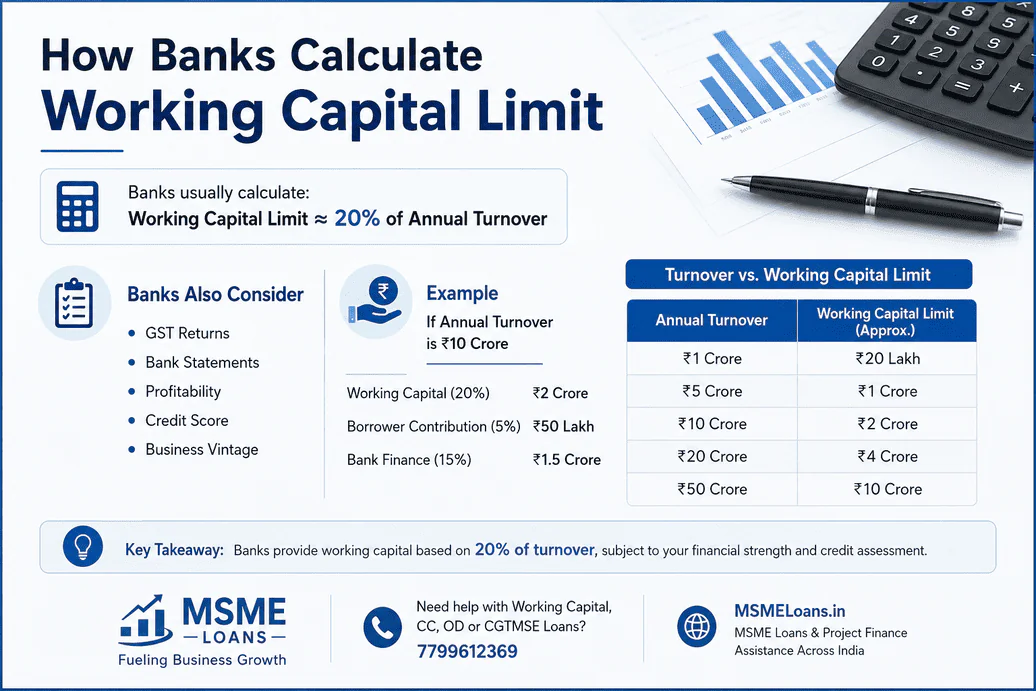
 Did you know banks typically assess working capital limits based on turnover, profitability, banking conduct, and GST returns? Learn how MSME working capital eligibility is calculated and what factors influence loan approval[/caption]
Most business owners assume that getting a working capital loan is simple: tell the bank your turnover, and the bank hands over a proportional amount of funding. In reality, banks follow a structured assessment process, and turnover is only the starting point.
Understanding this process can help you negotiate a better limit, prepare the right documents, and avoid surprises when your loan application is reviewed.
What Is a Working Capital Limit?
A working capital limit is a credit facility, usually structured as a Cash Credit (CC) or Overdraft (OD) account, that helps a business fund its everyday operational needs.
- Raw material purchases
- Supplier payments
- Inventory holding costs
- Salaries and operating expenses
- Receivables funding gap
The Turnover Method: How the Nayak Committee Formula Works
For MSME borrowers, banks commonly use the Nayak Committee Method to assess working capital requirements.
Working Capital Requirement Formula
Working Capital Requirement = 25% of Annual Turnover
Under this formula:
- Business contributes 5% of turnover
- Bank finances 20% of turnover
Working Capital Calculation Table
| Annual Turnover | Working Capital Requirement (25%) | Bank Finance (20%) |
|---|---|---|
| ₹1 Crore | ₹25 Lakh | ₹20 Lakh |
| ₹5 Crore | ₹1.25 Crore | ₹1 Crore |
| ₹10 Crore | ₹2.5 Crore | ₹2 Crore |
| ₹20 Crore | ₹5 Crore | ₹4 Crore |
Example
If a business has an annual turnover of ₹10 Crore:
- Total Working Capital Requirement = ₹2.5 Crore
- Borrower’s Contribution = ₹50 Lakh
- Bank Finance = ₹2 Crore
What Else Do Banks Evaluate for working capital limit?
Turnover is only the starting point. Banks also review:
GST Returns
Used to verify turnover and business activity of Last One year .
Bank Statements
Banks check average balances last one year , cash flow trends, and cheque returns.
Profitability
Higher profits generally support a larger working capital limit.
CIBIL Score
A strong credit history improves approval chances Below 700 most of the PSU banks wont event login. If they are any DPDs pending.
Existing Loan Obligations
Banks assess current debt levels and repayment commitments.
Business Vintage
Businesses with a longer track record are viewed more favourably minimum 2 year is required .
Can a Startup Get Working Capital Finance?
Yes, but approval depends on the startup’s business activity, financial profile and project viability. Since working capital limits are typically based on turnover, startups with no revenue history may find it difficult to obtain a Cash Credit (CC) or Overdraft (OD) facility from banks.
However, startups may still qualify if they have:
- Confirmed Purchase Orders (POs)
- Signed customer contracts
- Ongoing projects or revenue generation
- Experienced promoters
- Collateral security (if available)
- Eligibility under the CGTMSE collateral-free loan scheme
Manufacturing and service sector startups may also obtain collateral-free working capital finance under CGTMSE, subject to bank assessment and eligibility criteria.
Key Takeaway: While startups without sales history may face challenges, businesses with confirmed orders, strong promoters, or CGTMSE eligibility can still secure working capital funding from banks and NBFCs.
How Banks Assess Larger Working Capital Limits
For larger facilities, banks may use:
Maximum Permissible Bank Finance (MPBF)
Assessment based on inventory, receivables, and operating cycle.
Cash Budget Method
Used for seasonal and project-based businesses.
Key Takeaway
Bank Working Capital Limit ≈ 20% of Annual Turnover
However, the actual sanction depends on:
- GST compliance
- Banking conduct
- Profitability
- CIBIL score
- Existing liabilities
- Industry risk
Frequently Asked Questions
Is working capital always limited to 20% of turnover?
No. The final limit depends on the bank’s credit assessment and internal policies.
What documents do banks require?
GST returns, bank statements, financial statements, debtor-creditor lists, and KYC documents.
Can I get working capital without collateral?
Yes. Eligible MSMEs can avail collateral-free loans under CGTMSE.
What is the difference between Cash Credit and Overdraft?
Cash Credit is generally secured against stock and receivables, while Overdraft is often secured against property or deposits.
What is invoice financing?
Invoice financing provides funding against unpaid customer invoices.
Need Help Arranging Working Capital for Your Business?
We assist businesses with:
- Working Capital Loans
- Cash Credit (CC)
- Overdraft (OD)
- CGTMSE Loans
- Invoice Financing
- Project Finance
MSMELoans.in 7799612369