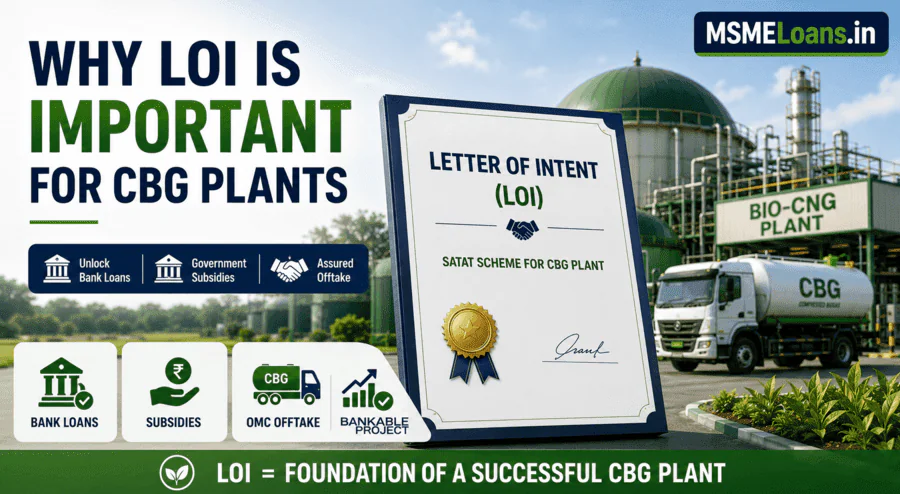
 An LOI (Letter of Intent) for a CBG plant is an official document issued by an Oil Marketing Company (OMC) — such as Indian Oil Corporation Limited (IOCL), Bharat Petroleum Corporation Limited (BPCL), or Hindustan Petroleum Corporation Limited (HPCL) — to a successful applicant under India’s SATAT (Sustainable Alternative Towards Affordable Transportation) scheme.
In simple terms, the LOI is a formal declaration by the OMC that it agrees to purchase the CBG you produce at a pre-determined price for a period of 5 years or more. It is essentially an offtake guarantee — a promise from a government-backed oil company that your product has a buyer before your plant is even built.
This makes the LOI the single most powerful document in your entire CBG project journey. As of July 2025, 1,094 active Letters of Intent have been issued under the SATAT scheme, with 108 CBG plants already commissioned across India.
Why Is the LOI So Critical?
The LOI does three things that no other document can do for your CBG project:
- It unlocks bank financing. For CBG Plants financing all top banks — including SBI, Bank of Baroda, Canara Bank, Union Bank, and IREDA — require a valid LOI from an OMC before they will process a CBG plant loan. The LOI is what converts your project from a business idea into a bankable proposal.
- It qualifies you for government subsidies. The MNRE’s Central Financial Assistance (CFA) of up to ₹10 crore per project is available only to LOI holders. Without the LOI, you cannot apply.
- It guarantees your revenue. OMCs generally offer a 5-year purchase agreement with an option to extend, and as of 2025, the procurement price from OMCs generally ranges between ₹62 to ₹72 per kg of CBG, determined by calorific value. This assured offtake gives lenders the confidence to finance your project.
Who Issues the LOI?
The Oil Marketing Companies — IOCL, BPCL, HPCL, and GAIL — are the nodal agencies for issuing LOIs and signing offtake agreements under SATAT. You apply to one or more of these OMCs through their e-tender or online portal, and if your Expression of Interest (EOI) is evaluated successfully, the OMC issues you the LOI.
The Ministry of Petroleum and Natural Gas (MoPNG) oversees the entire SATAT scheme and sets the rules for how LOIs are issued and managed.
How to Get an LOI for Your CBG Plant: Step by Step
Step 1: Prepare Your Expression of Interest (EOI)
Before you can receive an LOI, you must first submit an Expression of Interest (EOI) through the OMC’s official e-tender portal. Your EOI must clearly state your proposed plant location, feedstock source (agricultural residue, cattle dung, municipal solid waste, etc.), intended CBG production capacity, and basic financial information.
Step 2: EOI Evaluation by OMC Committee
After submission of documents through the e-tender portal, a committee of the particular OMC evaluates the EOI and awards the Letter of Intent to the successful applicant. The evaluation is based on predefined parameters including technical feasibility, feedstock availability, and financial viability.
Step 3: Accept the LOI and Submit Bank Guarantee
Once you receive your LOI, you must formally accept it. After accepting the LOI, applicants must submit a bank guarantee for safeguarding OMC investments towards retailing of the CBG. New applicants who are yet to set up plants must give a bank guarantee of ₹5 lakh per CBG plant within one month of the LOI being issued. Applicants with an existing biogas or CBG plant must give a bank guarantee of ₹1 lakh per plant within one month.
Step 4: Use the LOI to Approach Banks
With your LOI in hand, you can now approach any of the 10+ participating banks or IREDA for your CBG plant loan. The LOI is your primary supporting document for the loan application, alongside your Detailed Project Report (DPR).
Step 5: Sign the Commercial Agreement
After your plant is set up and commissioned, you sign a formal commercial agreement with the OMC, converting the LOI into a long-term offtake contract. CBG produced at your plant is then transported via cascades or pipeline to the OMC’s retail outlets and CNG stations for sale as green fuel.
Key Things to Know About Your LOI
- Minimum plant capacity: Your CBG plant must have a minimum designed capacity of 2 Tons Per Day (TPD) to be eligible for an LOI.
- Mandatory blending obligation: The CBG blending obligation (CBO) is now mandatory from FY 2025–26, set at 1% of total CNG/PNG consumption, rising to 3% in FY 2026–27 and 4% in FY 2027–28, and 5% from FY 2028–29 onwards. This means OMC demand for CBG is legally guaranteed to grow — making your LOI even more valuable.
- Change in firm constitution is allowed: If there are changes to your business structure after the LOI is issued, OMCs permit this through a formal intimation process — you are not locked into your original firm structure.
- Byproduct marketing is yours: Entrepreneurs can separately market other byproducts from CBG plants — including carbon dioxide and bio-manure — to enhance returns on investment. The LOI covers CBG offtake only; other revenue streams belong entirely to you.
Final Thoughts
The LOI is not just a formality — it is the foundation of your entire CBG plant business. It is what transforms your project from a vision into a viable, bankable, government-supported enterprise. Once you secure your LOI from an OMC, every other piece of the puzzle — bank loans, MNRE subsidies, land agreements, and technology partnerships — falls into place far more easily.
If you are serious about setting up a CBG plant in India, your first priority should be preparing a strong EOI and applying for your LOI today. With the CBG blending mandate now in force and India targeting 5,000 plants nationwide, the window of opportunity is wide open — but it won’t stay that way forever.
Disclaimer: This article is for informational purposes only. LOI terms, bank guarantee amounts, and scheme guidelines are subject to change. Always refer to the official SATAT portal and the respective OMC for the latest requirements.